














In today’s regulatory environment, façade design demands more than compliance - it demands certainty, particularly for building owners and housing providers responsible and accountable for resident safety.
As a manufacturer of classified A1, high-performance cladding systems, Valcan recognises that façade safety cannot be achieved through individual products alone. It requires a fully integrated, system-led approach, where every design is reviewed holistically as a system to ensure compatibility.

Image © Valcan
Working in collaboration with passive fire protection specialist Siderise, Valcan is championing a more joined-up model for façade design - one that minimises risk, improves installation on site, reducing the risk of defects, delays and costly remedial works, while delivering greater confidence in long-term performance.
At its core is a principle the industry can no longer ignore - buildings do not fail because of a single element, they fail where systems don’t connect.
The Risks of Treating Façades in Isolation
The façade industry has historically taken a fragmented approach, with cladding, insulation and firestopping often specified in isolation. Michael Croxford from Siderise highlights, this has never been adequate.
“We feel that it has never been sufficient to consider individual components in total isolation,” Michael explains. “While it is without doubt essential to determine the standalone performance of products, the critical risks often arise at the interfaces between components rather than within any single product on its own.”
These interface points - where cavity barriers meet rails, brackets, insulation and panels - are often weak links in façade fire performance.
“A product may perform as intended in isolation, but if components are not properly coordinated the overall system may not maintain compartmentation or perform as required in a fire event.
This shift in understanding is driving a move toward system thinking across the industry.
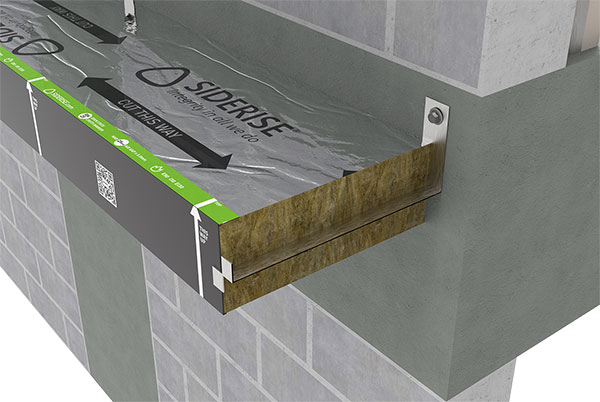
Image © Siderise
Why System Thinking Matters for Façade Safety
System thinking recognises that performance is defined not just by individual products, but by how they work together under fire conditions.
As Michael explains, risk is shaped by the built assembly, not just component performance: “Fire does not respect product boundaries - it follows the path created by the built assembly, particularly where different materials, fixings and systems come together.”
Testing plays an important role but must be correctly understood.
“It is important for designers to note that large scale testing to the likes of BS 8414-1 & 2 and NFPA 285 is only intended to test the combustibility (reaction to fire) of the façade system and not the fire resistance of any of its elements individually,” Michael notes. “Therefore, it cannot be used as evidence that the cavity barrier products used achieve prescribed fire resistance requirements.”
Instead, system testing should be seen as part of a broader evidence base, reinforcing the need for a holistic approach: “The resulting data can be useful to gain insight into the way in which different components, dimensions and features work together.”
Where Façade Risk Really Lies
While product performance remains important, risk is most acute where systems intersect and where design meets site reality.
“Risks are often a result of a combination of factors,” says Michael, “even the most robust and carefully considered design can underperform if not specified or installed correctly.”
This highlights a critical industry challenge - aligning design intent with on-site execution. Michael continued: “The installation must meet design intent but equally the design must take into consideration practical challenges, clashes or changes in conditions onsite.”
In practice, the most vulnerable areas are well understood: “Around slab edges, openings, balconies, support brackets, movement joints - where hidden voids, geometric complexity… and poor-quality workmanship can create routes for fire, smoke and hot gases if not properly resolved.”
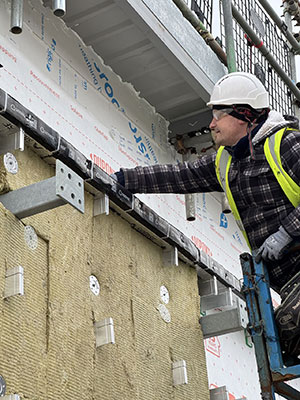
Image © Siderise
Reducing Façade Risk Through Collaboration
A joined-up façade relies on early-stage coordination. For Valcan and Siderise, this collaboration is central to achieving compliant, buildable systems.
Michael emphasises the importance of early engagement: “Early-stage coordination is very important; it ensures that all potential design challenges have been considered and addressed to ensure compatibility between systems.”
Critically, decisions must be based on high-quality, reliable information: “The quality of information used to make design decisions is also critical. It should be evidence based and in line with CCPI guidelines, clear, accurate, up-to-date, accessible and unambiguous.”
This aligns directly with the expectations of the Building Safety Act and the broader push for accountability across the supply chain.
Addressing Complex Façade Interfaces
Some façade details remain inherently complex, none more so than balcony interfaces, where structure and fire protection must work within tight spatial constraints. As Michael explains, “to maintain compartmentation in a fire event, the continuation of cavity barriers is essential.” However, this can be difficult to achieve where “structural steel brackets frequently occupy the full depth of the slab edge, leaving little space for cavity barrier continuity.”
Traditional approaches often introduce risk. Solutions such as notching barriers around brackets are “highly dependent on installer skill and are rarely supported by fire tested evidence,” leading to inconsistencies between design intent and on-site delivery.
To address this, Siderise has developed a system-led solution: “a kit of pre-cut, interlocking fireboards that fully encapsulates balcony brackets at the slab edge.” By replacing bespoke detailing with a tested, repeatable method, it offers a clearer route to consistency. As Michael notes, “the pre-configured nature of the system reduces reliance on site interpretation, enabling consistent fire performance to be achieved across multiple storeys.”
For housing providers, this helps reduce uncertainty in both compliance and delivery on complex residential schemes.
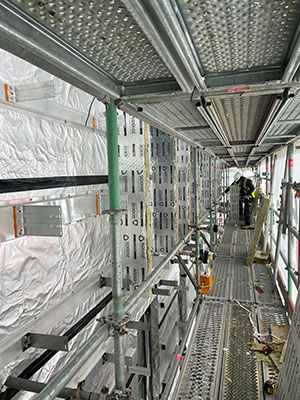
Image © Siderise
How Regulation is Raising the Bar for Façade Safety
The introduction of the Building Safety Act has significantly accelerated the industry’s shift toward system-based thinking. As Michael describes, it represents “a significant overhaul - introducing stricter regulations and impacting product specification and compliance as well as accountability.”
This regulatory shift has not only raised performance expectations but also reinforced the need for greater collaboration across the supply chain. “Since the introduction of the Building Safety Act it has become more important than ever that system manufacturers collaborate to ensure individual products work as part of a system,” Michael explains.
At the same time, the level of scrutiny around evidence and documentation has increased considerably. As Michael notes, “the amount of information we’re required to understand, manage, and evidence has grown significantly.”
In response, manufacturers are evolving how they support design teams - moving beyond traditional product data sheets to provide structured digital resources, test data visualisation, and detailed, project-specific specification packs. These tools play a vital role in supporting Gateway submissions and maintaining the golden thread, ensuring that decisions are underpinned by clear, accessible, and verifiable information throughout the project lifecycle.
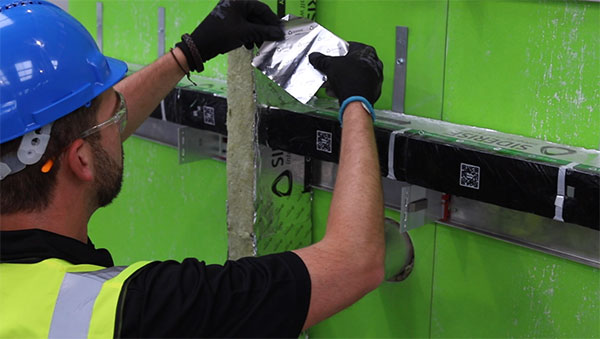
Image © Siderise
Delivering Façade Safety on Site
Even the most robust system design ultimately relies on effective installation. As Michael emphasises, “in order for passive fire protection systems to function, it is crucial that they are installed in line with manufacturer requirements which replicate how they have been tested.”
This places a clear emphasis on competence across the supply chain. “Installer competence plays a significant role in site quality control… and ultimately the performance of the product as intended,” he explains, highlighting the direct link between workmanship and real-world safety outcomes.
Ensuring that installers have the right knowledge and support is therefore essential. Training and early engagement with manufacturers can make a significant difference, with Michael noting that “working with manufacturers who provide practical onsite training can provide installers with invaluable insight.”
At the same time, system-led approaches can help reduce reliance on interpretation during installation. As he points out, “the pre-configured nature of the system reduces reliance on site interpretation,” improving consistency across projects and helping to minimise the risk of errors on site.
Together, these factors play a crucial role in bridging the gap between design intent and as-built performance, ensuring that fire safety measures deliver as intended in practice.
Delivering Safer Buildings Through System-Led Design
Ultimately, a joined-up approach is about aligning design, specification and construction into a single, coherent system - one that performs as intended.
As Michael concludes, “collaboration between manufacturers is essential. When they work collaboratively, they can assist design teams in developing robust designs that can be accurately replicated by on site teams.”
This ability to translate design intent into consistent, buildable solutions is central to improving outcomes across the built environment.
For Valcan, this philosophy underpins its approach to façade design. By working in close partnership with Siderise, the company is helping to drive a more coordinated model - one that ensures cladding systems and fire protection solutions are developed, tested and delivered as a unified whole.
The benefits are clear: improved compliance, reduced risk, better build quality, and greater confidence for specifiers, contractors and building owners alike.
As the industry continues to adapt to evolving regulation and heightened expectations, a joined-up façade is a safer façade and system-led design is no longer a preference, but a necessity for delivering safe, compliant residential buildings.
For housing associations and building owners, this means placing greater emphasis on system-led specifications, early manufacturer engagement, and demonstrable, joined-up evidence when procuring façade solutions.
Fore information about complete cladding systems from Valcan visit www.valcan.co.uk.
For more information about Siderise and their high-performance passive fire protection solutions visit www.siderise.com
- Log in to post comments