

















Amid seismic regulatory change, one thing is clear: for local authorities and housing associations delivering social housing, the era of doing things by habit or assumption has passed.

As the manufacturing and supply partner for windows, doors and fire doors working directly with councils and housing providers, at Shelforce we believe this new landscape demands sharper clarity, stronger traceability and a supply chain that can genuinely deliver to the new standard.
This year I spoke on a panel at the Glazing Summit about skills and apprenticeships in the fenestration industry and had the opportunity to listen to an important presentation on the rise of the super regulator from Jon Vanstone, Chair of Certass, NHIC, and the Industry Competence Committee for the Building Safety Regulator, which put the spotlight on the intense scrutiny fire doors, glazing systems and other fenestration components will now be under.
A rising super-regulator and what it means
The regulatory environment is evolving rapidly. The Building Safety Regulator (BSR) has increasingly assumed responsibility for higher-risk buildings, and we are witnessing the emergence of what many are calling a “super-regulator” model: a unified oversight combining design, product supply and construction execution.
For fire doors, doorsets and glazing systems supplied into social housing projects, this means a much sharper focus on accountability across the supply chain, not just on site-install but upstream manufacture, documentation and traceability and a requirement for outcome-based compliance rather than just ticking regulatory boxes, with the regulator seeking demonstrable evidence that parts perform within the whole building safety system.
For local authorities specifying fire doors in refurbishment or new build social-housing schemes, the message is straightforward; you must ask more of your suppliers and demand more documentation and more traceability.
And, of course, it’s important for manufacturers to remember that it’s not just fire doors that need to be documented; every window and door matters in the new regime too, with documentation covering structure, thermal, and moisture performance needing to be ready for submission too.
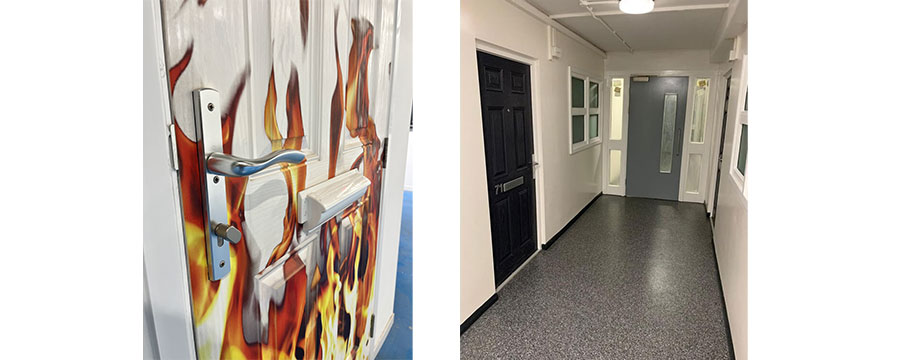
Shelforce's FireShel fire door
Why Gateway 2 is now a critical pinch-point
I spoke about Gateway 2 earlier this year. Under the Building Safety Act, higher-risk buildings (those 18 m+ or seven storeys and above) must pass three regulatory gateways: one at planning, one before construction begins (Gateway 2) and one at completion (Gateway 3).
Gateway 2 is a stop-go moment, and construction cannot commence without the regulator’s green light. It also forces every stakeholder, designers, contractors, installers, and manufacturers, to prove their competence and take responsibility.
Even for lower-rise social housing or mainstream refurbishment (which may not fall under the full HRB Gateway regime), the heightened regulatory culture means standards are rising across the board. Suppliers who aren’t prepared will slow you down.
The problem is that the process is slow, and Gateway 2 applications are not at present being approved within the target time of 12 weeks. This leads to a shortage of approvals and a backlog at the regulator holding up major schemes, increasing risk for the supply chain and jeopardising project viability.
Another problem is that, too often, the people responsible for compiling this data are still not clear on their roles, their responsibilities, or even how to navigate the process.
Golden thread traceability
A new mindset that supply chain partners must assume a role in the “golden thread” of building information. The golden thread describes the requirement that building information be accessible, accurate, up to date and managed throughout a building’s life.
Suppliers must be able to provide the entire “golden thread” of evidence, not just a CE or UKCA mark and those documents must align with the regulator’s expectations for Gateway 2 submissions.
For fire doors this means you cannot simply deliver a door and walk away. You must consider manufacturing record, batch traceability, performance testing, installation record, hand-over documentation, commissioning record, and ongoing maintenance record.
For social-housing refurbishments and new-builds this has very practical implications:
• Specification: Your fire-door product spec must clearly align with the building’s overall fire-strategy, compartmentation and evacuation scenario.
• Manufacture: The supplier must retain records of materials, production batch, quality control and test performance.
• Installation: You must capture the installer’s competence, the site-records, installation sign-off and commissioning evidence.
• Hand-over: The building safety file (or fire-safety file) must contain evidence of the doorset, with traceability to the door-leaf, frame, hardware, seals, intumescent kits and fixings.
• Maintenance: The golden thread does not stop at hand-over; it must continue through maintenance and periodic inspection.

Shelforce employee's in the Shelforce factory
A partner approach
For local authorities this means your procurement process must insist on these levels of detail. Thanks to our experience at Shelforce, we know social housing providers and local authorities have multiple pressures, from budgets, timescales and tenant safety to retrofit obligations and new builds.
In a world of rising liability, you want a supplier who understands the regulations, the traceability, the documentation and can provide confidence not just product.
At Shelforce we are proud to partner with several local authorities and housing associations. We are not just a supplier, you can rely on us as a compliance partner; we embed traceability in our supply-chain and documentation so our clients can confidently pass audit, Gateway 2 submission and ongoing safety assurance and every fire door is built to the same high standard, with no corners cut.
The final word
The regulatory world has shifted; the super-regulator model is taking shape and Gateway 2 is now a critical juncture.
As Business Manager at Shelforce I believe we must stand beside our local authority and housing association clients as partners, not just suppliers. We must help you navigate the documentation, support you through procurement and deliver fire doors, doorsets and glazing systems you can trust, backed by full traceability and audit-ready data.
Because behind every fire door we manufacture, there is a home. A resident. A person. And when the regulators ask for evidence, our clients should be ready, and so should we.
For further information call 0121 603 5262 or visit www.shelforce.com.
Images © Shelforce
- Log in to post comments