
















Leading ventilation manufacturer Vent-Axia has welcomed the Future Homes Standard, alongside the publication of new Approved Document Part F (Means of Ventilation) of the Building Regulations, and Part L (Conservation of Fuel and Power), as “a significant step on the road to Net Zero.” The Future Homes Standard is expected to deliver homes that produce 75-80% fewer carbon emissions compared to 2013 standards, representing a major shift in how new homes are built.
However, as buildings become increasingly air-tight, it is essential to consider indoor air quality (IAQ) too to protect occupants’ well-being. As carbon reductions become more ambitious, achieving compliance becomes more complex for housebuilders, meaning well-designed, correctly installed, and effectively commissioned ventilation systems are more important than ever. Vent-Axia therefore welcomes the strengthened focus on competency within the updated guidance, recognising that good ventilation design will play an essential role in delivering energy-efficient, low-carbon homes.
Within Part F, there is now clear guidance that greater care should be taken when installing a mechanical ventilation system, particularly centralised systems, and to ensure that both the following are met: a. “The person carrying out the work is suitably competent (for example, they are a registered competent person). b. The work meets the requirements of the Building Regulations.”
For ventilation installation work, compliance with Building Regulations must be demonstrated using one of two routes: self-certification by a registered competent person, or certification by a building control body. When an installer is not a registered competent person, Part F gives clear guidance on how to obtain sign-off through building control. This guidance looks set to raise ventilation installation standards, improving building performance and so lowering carbon emissions.
In addition, Part F introduces guidance that those commissioning and testing mechanical ventilation systems should also be trained and be a member of an organisation that independently verifies their competence. For ventilation installers, these amendments offer a clear incentive to register with a competent person scheme.
There is also increased emphasis on system design, including the need to consider airflow performance and resistance in ductwork. The addition of maximum design system pressure for Mechanical Ventilation (MEV) and Mechanical Ventilation with Heat Recovery (MVHR) systems, depending on flow rates, means that designers need to look carefully at each design and ensure pressure calculations are completed. Vent-Axia welcomes these amendments as they will help improve the overall design of ventilation systems and support the uptake of lower specific fan power (SFP) solutions, as well as more advanced systems such as MVHR.
Part L also introduces tighter SFP targets across ventilation, supporting improved energy efficiency. Intermittent fans remain at 0.5W/l/s, while, MEV is now split between decentralised Mechanical Ventilation (dMEV) and centralised MEV with dMEV 0.3W/l/s and MEV 0.5W/l/s for new build. MVHR systems are reduced to 1.4W/l/s for new build.
Meanwhile, Part F also brings changes to ducting, with a further shift away from flexible ductwork. For continuous MEV or MVHR the guidance states that rigid or smooth semi-rigid ducting should be used. For intermittent extract fans or dMEV rigid ducting should be used with duct lengths kept to a maximum of 2m where possible. Where duct runs exceed 2m, a competent person must provide detailed design calculations and drawings to building control to show that the required air flows are achieved. These changes look set to improve ventilation system design since the tightening of limits will mean systems will need to be designed more carefully.

Joe Brawn, Product and Marketing Director at Vent-Axia (Image © Vent-Axia)
“We welcome the Future Homes Standard and the clarity it provides housebuilders, and how we can help them on the Net-Zero journey. At Vent-Axia we are committed to both a low-carbon future and the health and well-being of people. We therefore welcome the new focus on competency, the drive for better system design, and improvements in specific fan power within Part F. As carbon targets rise and homes become more airtight, it will become even more important to ensure ventilation systems are correctly designed, installed, and commissioned to ensure good indoor air quality,” said Joe Brawn, Product and Marketing Director at Vent-Axia.
Vent-Axia is committed to best practice and has been championing competency for over a decade, with the company running NICEIC Domestic Ventilation Training Course at its Crawley training suite. Demand for the course has risen significantly, initially following COVID and then again with the launch of Awaab’s Law. The latest changes to Part F are set to drive a further uptake in the course. Vent-Axia is already prepared for this growth with a new training facility set to open at its Dudley manufacturing site in the coming months.
Vent-Axia’s NICEIC Domestic Ventilation Training Course is a two-day course aimed at anyone with an interest in installing ventilation systems, particularly experienced electricians, plumbers, ventilation installers and heating engineers looking to improve their knowledge and understanding of domestic ventilation systems. It also looks at legal requirements, why ventilation is important and the different types of ventilation available. This includes information on the updated Building Regulations to ensure installers are aware and comply with the new changes.
The course meets the minimum technical competency requirement for Installers looking to apply to join a Competent Person Scheme in England and Wales for Domestic Ventilation Systems and is also relevant for installers working in Scotland and Northern Ireland. The course has been designed to provide the necessary skills in design, installation, testing, commissioning, handover, servicing and fault-finding of ventilation systems in accordance with the latest National Occupational Standards (NOS) and Minimum Technical Competency documents (MTC).
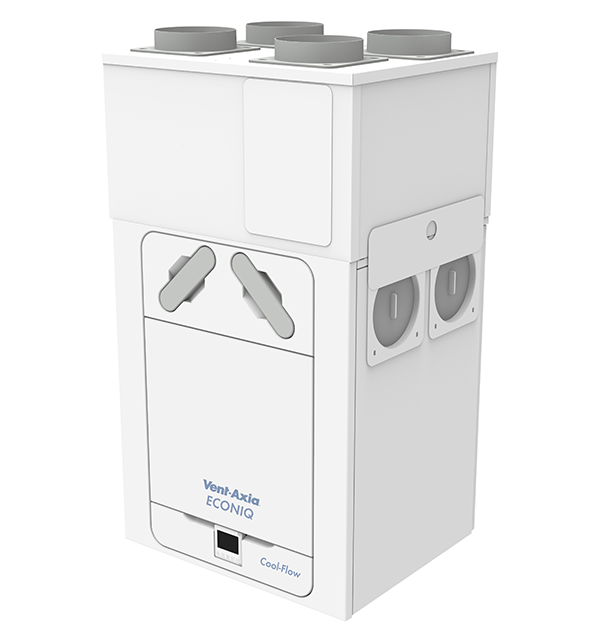
Vent-Axia Lo-Carbon Sentinel Econiq-Cool-Flow (Image © Vent-Axia)
Alongside good design and installation, selecting a high-performance ventilation system is essential to ensure adequate airflow and energy efficiency are achieved in practice. To meet these requirements, the ideal solution is MVHR since it provides healthy filtered air, supplying and extracting air continuously, while recovering heat that would be otherwise lost. To reduce carbon emissions, it is vital to select an MVHR with a low SFP in conjunction with a high heat recovery, but complete controllability is essential too, to maintain high levels of IAQ and comfort for occupants. Vent-Axia’s award-winning Lo-Carbon Sentinel Econiq MVHR range has been designed to meet these challenges with best-in-class SFP levels, 93% heat recovery and complete controllability. The range includes four core models: the Lo-Carbon Sentinel Econiq; Passivhaus-certified units; the Sentinel Econiq Cool-Flow, which integrates DX cooling; and the Sentinel Econiq-Cool (KERS), which combines an MVHR unit with the KERS Coolboost hot water air source heat pump.
For further information on all products and services offered by Vent-Axia telephone +44 (0)344 856 0590 or visit www.vent-axia.com.
- Log in to post comments