
















Applying a smoothing compound to a subfloor is recommended to provide suitably smooth base for the receipt of new floor coverings. Which will help to ensure a visually attractive finish. Where refurbishments are taking place and adhesive residues are left behind following the removal of old floor coverings, smoothing compounds are available that can be applied directly over these, eliminating the usual need to spend valuable time mechanically removing them.
Such products are formulated to minimise the stresses inflicted on adhesive residues as the smoothing compound sets so that they maintain their integrity and do not debond from the subfloor, potentially compromising the installation. In most cases, there is no need to apply a primer before application, saving further time and expense.
The best of these smoothing compounds are usually able to accept foot traffic about one hour after application and are ready to receive new floor coverings from around four hours later. They also have the benefit of allowing contractors to use the same product in situations where newly installed subfloors and areas with old adhesive residues present are next to each other.
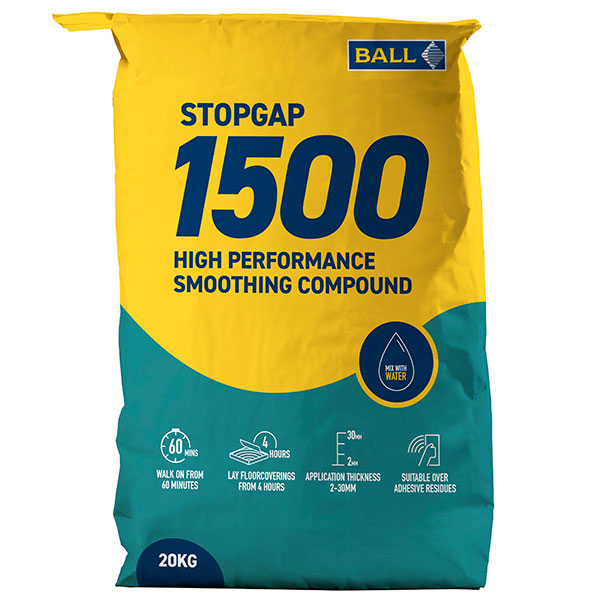
Image © F. Ball & Co. Ltd
New formulations
The latest advancements in technology have enabled F. Ball and Co. Ltd. to create a new fast-track, water-mix smoothing compound that can be applied over old adhesive residues, Stopgap 1500. Such products have previously only been available in bag and bottle formulations.
The new smoothing compound is suitable for preparing a wide range of sound internal subfloors in commercial and residential settings prior to the installation of new floor coverings and can be applied over a wide range of insoluble, well-bonded adhesive residues, including bitumen, carpet tile tackifiers and ceramic tile adhesives.
Just as with market-leading bag and bottle versions, the product is walk-on hard in as little as 60 minutes after application and ready to receive floor coverings from just four hours. As a water-mix smoothing compound, no bottle is required, meaning less plastic waste is produced by the flooring industry.
Prior preparation
Before the smoothing compound is applied, contractors should begin any flooring installation by ensuring the subfloor is suitably sound and dry. This may necessitate repairs to the subfloor or the removal of surface contaminants apart from old adhesive residues, such as oil, grease, paint or other chemicals.
F. Ball recommends that a moisture test is then conducted to determine subfloor moisture levels. Where a moisture test indicates that the relative humidity (RH) level within the subfloor is above 75% (65% if bonded wood floor coverings are to be installed), a waterproof surface membrane will be required to prevent floor failure.
After these steps have been undertaken, the application of an appropriate smoothing compound is the final stage in the subfloor preparation process before new floor coverings can be installed.
f-ball.com
- Log in to post comments